
Celebrate 15 years of silent programming at the Revue Cinema with Silent Revue (Alicia Fletcher) and Designing the Movies (Nathalie Atkinson)!
“I looked into the streets—the glaring lights and the tall buildings—and there I conceived Metropolis. The buildings seemed to be a vertical sail, scintillating and very light… suspended in the dark sky to dazzle, distract and hypnotize”. – Fritz Lang
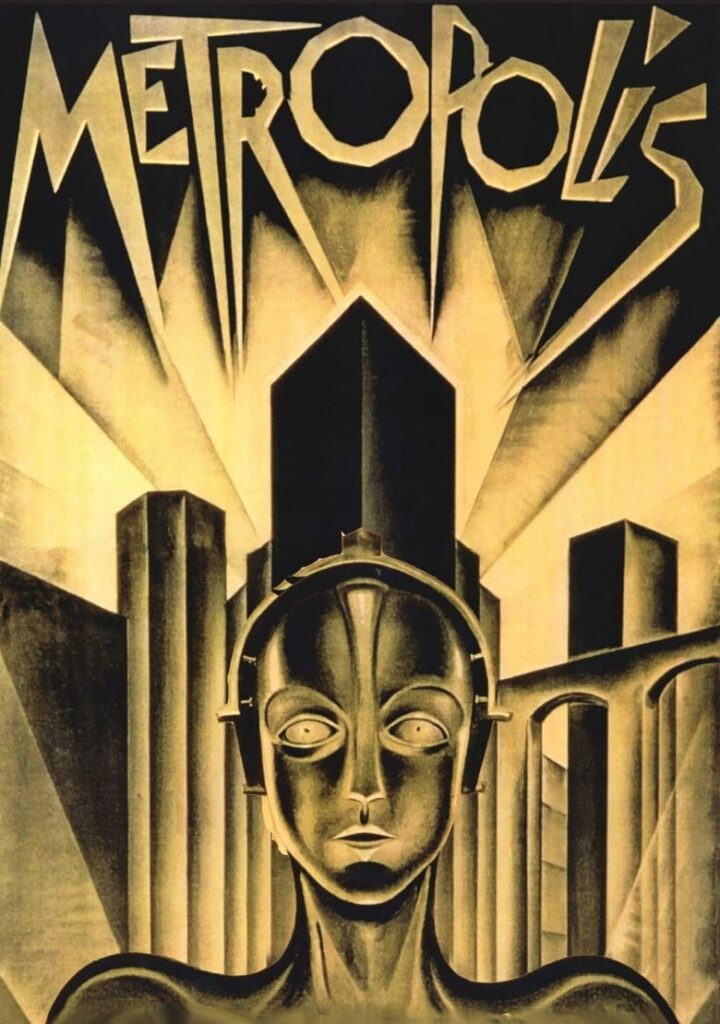
As gleamingly modern as it is vested in the ancient and medieval, METROPOLIS launched the science fiction epic and popularized the movie genre mash-up—as Shelley’s Frankenstein had done for literature the century prior. Starring the legendary Rudolf Klein-Rogge as a tortured scientist, the luminous Brigette Helm as both the virtuous Maria and her nefarious robotic doppelganger, as well as Gustav Fröhlich, METROPOLIS is the pinnacle of German Expressionist filmmaking, as well as its downfall. While it may have marked the end of an era, this co-presentation of METROPOLIS celebrates fifteen years of silent film programming at the Revue, proving that great film art is everlasting.
With production design by Erich Kettelhut—working alongside Otto Hunte and Karl Vollbrecht—in METROPOLIS Art Deco, Bauhaus and Futurism co-mingle with the ruggedly Gothic. While a box office bomb in its time, for the past century, METROPOLIS has exerted profound design influence—from C-3PO, to Madonna, to Thierry Mugler’s lauded runway and Zendaya’s recent resurrection of the fashion house’s homage to the “Maschinenmensch.” Timeless and yet alarmingly timely, METROPOLIS is Weimar filmmaking at its finest and most prophetic.
Presentation format: 2010 Restoration courtesy Kino Lorber
Live accompaniment by Tania Gill
Silent Revue is curated by Alicia Fletcher
Designing The Movies is curated by Nathalie Atkinson
Silent Revue is sponsored by Hollywood Suite